
In this guide
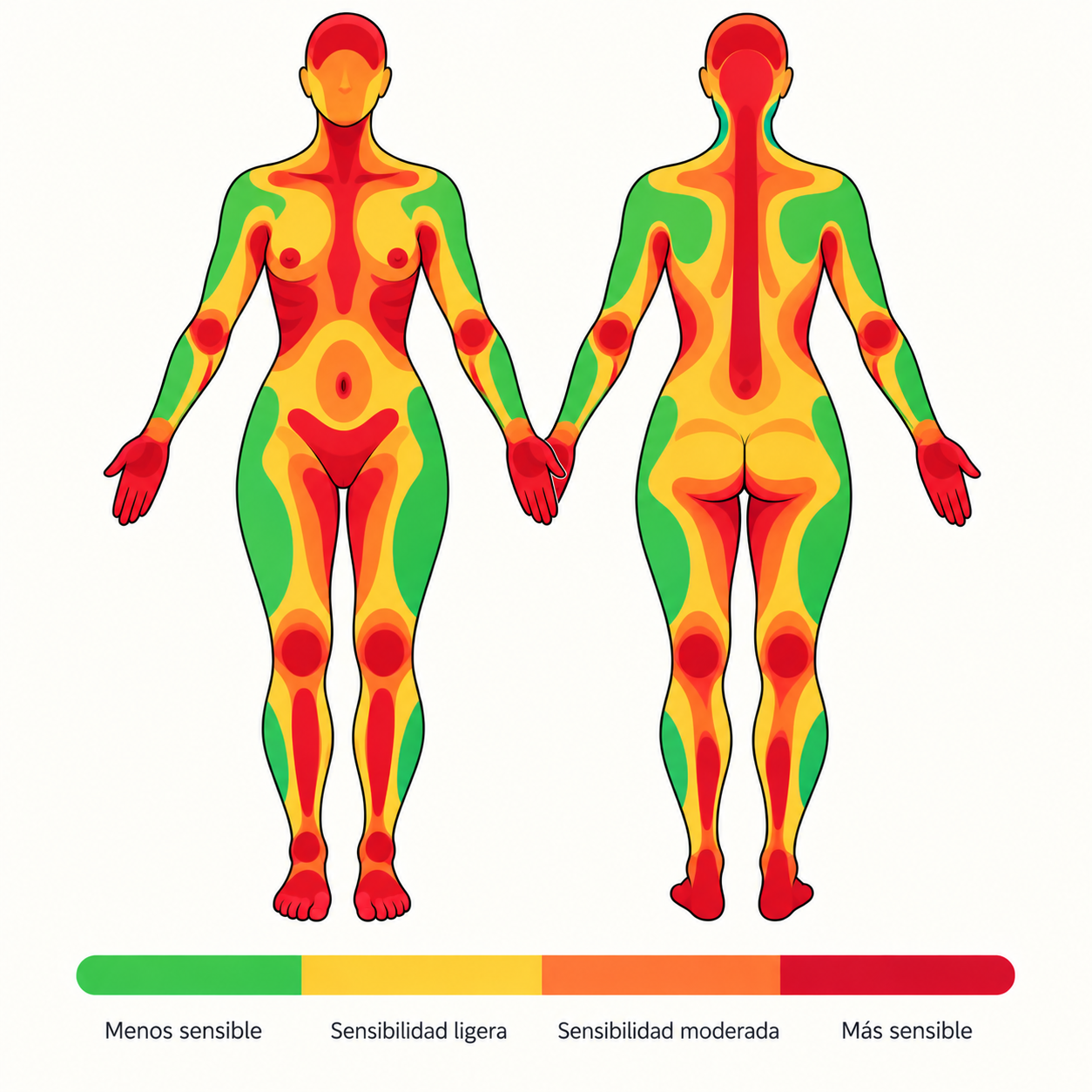
The map is a general guide. It isn’t a medical scale, and it can’t predict how your own session will feel. The colours group what usually happens. They aren’t exact scores, and they can’t be used to compare two people.
Why some areas feel more sensitive
How it feels depends on how thick your skin is and how much tissue sits between the skin and the bone. Where there is less tissue, pressure and vibration are easier to notice. Some areas are also more sensitive in themselves, for example because they have more nerve endings.
Areas that bend a lot, like the inside of the elbow or the back of the knee, can also feel more sensitive. And the longer the session, or the more one spot has to be worked, the more you may notice it.
None of this tells us exactly what you will feel. Tolerance, tiredness, stress and previous experience matter too.
Areas that often feel more sensitive
This isn’t a ranking, and it’s different for everyone. Many people feel more in areas with little tissue over the bone, areas with folds, and areas that move a lot:
- Ribs and sternum. Also nipples and areolae, where sensitivity varies a lot from person to person.
- The armpit, inner upper arm and the crease of the elbow.
- Wrists, hands and fingers, because bones and tendons are close to the skin and there is little tissue around them.
- The groin and upper inner thigh, delicate areas where you notice every movement.
- Knees, the back of the knee, shins, ankles and feet.
- Spine, neck and head, where the bone is close and vibration can be easier to notice.
Even within the same area, the experience changes with the shape of your body, the design and the exact spot.
Areas that are often more manageable
Many people find the outer shoulder, outer upper arm and forearm, the side of the thigh, most of the calf and the upper back away from the spine easier to handle. There may be more tissue between the skin and the bone in these areas.
“More manageable” doesn’t mean it doesn’t hurt. A long session, fine detail or your own sensitivity can change things completely.
The tattoo itself matters too
Size, placement, level of detail and technique all affect how long the session lasts and how it feels. If the same spot has to be gone over many times, the skin notices. Tiredness and stress count too.
An observational study of 1,092 participants found that reported pain was linked to factors such as session length and stress. It doesn’t give a universal pain scale by body area, and it can’t predict what one person will feel.
How to arrive ready for your session
Get a good night’s sleep, eat normally and drink water. Don’t come under the influence of alcohol or other substances. You’ll find the rest in the preparation and aftercare guide. Don’t take any medication on your own just to get through the session. If you have questions about a treatment, ask a healthcare professional.
If you’re choosing between two areas
If you’re torn between two areas for the same design, tell me when you send your request. I’ll explain how the size and composition would change and what to expect from each placement. Sending a request doesn’t book a date, and you don’t pay anything.